Indonesia
 English
 Arabic
 French
 Spanish
 Portuguese
 Deutsch
 Turkish
 Dutch
 Italiano
 Russian
 Romaian
 Portuguese (Brazil)
 Greek
Mobile App Development Contracts in Dubai: Scope, Deliverables and Ownership
Other |
2026-11-05 10:18:32
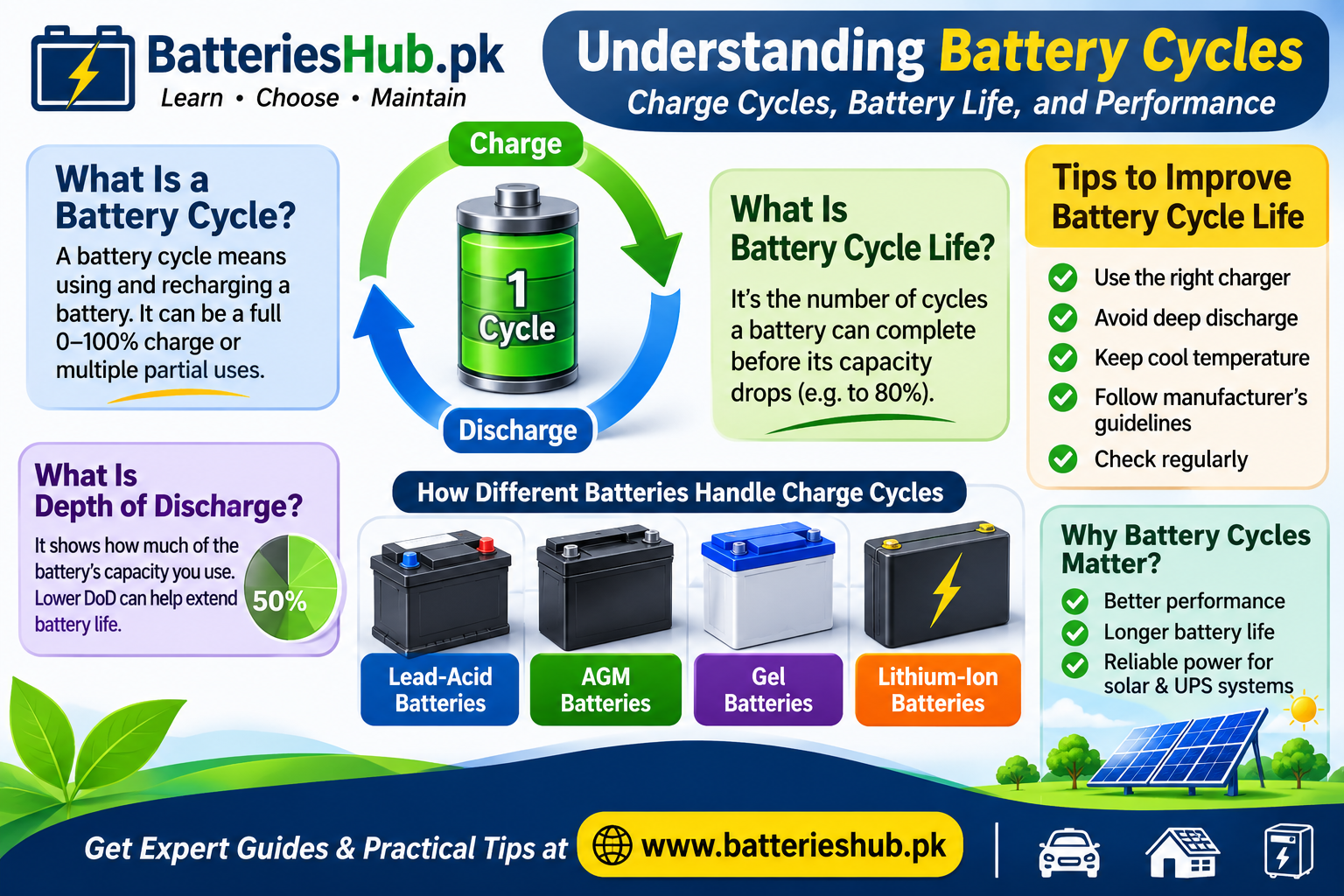
Batteries are an important part of modern technology, providing power for vehicles, smartphones, solar energy systems, UPS units, and many other applications. However, every rechargeable battery has a limited service life. One important factor used to understand battery lifespan is the battery cycle.
Understanding how battery cycles work can help users choose suitable batteries, improve charging habits, and maintain better battery performance. Whether you use a lithium-ion, AGM, gel, or lead-acid battery, knowing about charge cycles can help you make informed decisions.
A battery cycle refers to the process of using and recharging a battery. A complete cycle generally represents the use of an amount of energy equal to 100% of the battery's rated capacity.
For example, if you use 50% of a fully charged battery and recharge it, then later use another 50%, these two uses together represent approximately one full cycle.
A battery cycle does not necessarily mean charging a battery from 0% to 100% in one session. Partial discharges and recharges also contribute to the total cycle count.
Battery cycle life is the number of charge and discharge cycles a battery can complete before its capacity decreases to a specified level.
For example, a manufacturer may specify that a battery can provide a certain number of cycles before its remaining capacity reaches 80% of its original capacity.
Cycle life depends on several factors, including:
Battery chemistry and design
Charging and discharging conditions
Operating temperature
Depth of discharge
Charging voltage and current
Storage conditions
Different battery technologies have different cycle-life characteristics. Explore battery fundamentals and different battery technologies to learn more.
Depth of Discharge, commonly called DoD, describes how much of a battery's capacity has been used.
For example:
20% DoD means approximately 20% of the battery's capacity has been used.
50% DoD means approximately half of its capacity has been used.
80% DoD means approximately 80% of its capacity has been used.
Depth of discharge is important because repeatedly using a battery at very deep discharge levels can affect its lifespan, depending on the battery chemistry.
Some batteries are designed to support deeper discharges than others. Always follow the manufacturer's recommended operating limits.
Battery chemistry plays an important role in cycle life and performance.
Lead-Acid Batteries: These batteries are commonly used in vehicles, UPS systems, and backup applications. Their lifespan can be affected by frequent deep discharges and improper charging.
AGM Batteries: AGM batteries are a type of sealed lead-acid battery. They are commonly used in automotive and backup applications and require compatible charging settings.
Gel Batteries: Gel batteries use a gel-based electrolyte and are available for certain backup and deep-cycle applications. They need suitable charging voltage to help prevent damage.
Lithium-Ion Batteries: Lithium-ion batteries are widely used in portable electronics, electric vehicles, and energy storage systems. Their cycle life depends on chemistry, temperature, charging conditions, and operating limits.
Good charging and usage habits can help maintain battery performance.
Consider these practical tips:
Use a charger compatible with your battery type.
Avoid excessive heat during charging and operation.
Follow the manufacturer's recommended discharge limits.
Avoid leaving batteries discharged for extended periods when the manufacturer advises against it.
Store batteries under recommended conditions.
Inspect battery terminals and connections regularly.
Use appropriate battery management and protection systems where required.
You can learn more about proper battery charging methods and battery maintenance practices to help keep your batteries in good condition.
Battery cycles are particularly important for solar energy storage and backup power systems.
Solar batteries may charge during the day and discharge when electricity is needed. This repeated operation contributes to their cycle count.
Similarly, UPS and inverter batteries provide backup electricity during power interruptions. Their cycle life can be affected by how frequently they are used and how deeply they are discharged.
When choosing a battery for these applications, consider its rated cycle life, usable capacity, warranty, charging compatibility, and expected daily usage.
Explore solar battery guides and UPS and inverter battery information to understand your energy storage options.
A battery may need replacement when it can no longer provide sufficient power for its intended application.
Some common warning signs include:
Noticeably reduced backup time
Frequent charging problems
Unexpected voltage drops
Difficulty starting a vehicle
Swelling, leakage, or physical damage
Repeated battery test failures
Cycle count alone does not determine whether a battery needs replacement. Actual condition, capacity, safety, and manufacturer recommendations should also be considered.
Battery cycles provide useful information about rechargeable battery usage and expected lifespan. Understanding charge cycles, depth of discharge, battery chemistry, and charging practices can help users make better decisions and maintain reliable battery performance.
For more practical battery information, expert guides, and easy-to-understand explanations, visit BatteriesHub.pk. Discover helpful resources covering battery types, charging, solar energy storage, maintenance, and battery safety.
Website:https://batterieshub.pk/
Email:hello@batterieshub.pk
Contact:+92 333 4790 945