Indonesia
 English
 Arabic
 French
 Spanish
 Portuguese
 Deutsch
 Turkish
 Dutch
 Italiano
 Russian
 Romaian
 Portuguese (Brazil)
 Greek
Knee Replacement Surgery in India – Advanced Treatment at Affordable Costs
Health |
2026-11-26 07:25:16
After a hard training session, muscle soreness can make stairs, squats, or even getting out of bed uncomfortable. But not every painful muscle or joint is simply recovering from exercise. If you are considering how acupuncture for sports injuries may fit into a recovery plan, first work out whether you are dealing with expected post-exercise soreness or a problem that needs assessment. Acupuncture should not be used to hide pain from an injury or to decide whether it is safe to keep playing.
The difference matters because training through an injury can make it harder to recover. A sensible approach begins with the timing and location of symptoms, how they affect movement, and whether any warning signs are present.
Delayed-onset muscle soreness, often called DOMS, commonly develops after unfamiliar or particularly demanding exercise. It may occur after a new strength routine, downhill running, repeated jumping, or a session that places more load on the muscles than usual.
A sports injury can also cause pain, tenderness, stiffness, or reduced movement. A muscle strain, ligament sprain, tendon problem, or joint injury may initially feel like ordinary soreness, especially if the symptoms are mild.
The timing and pattern can offer clues, but they cannot confirm a diagnosis. If you are unsure, or if pain is affecting normal movement, get an appropriate assessment rather than trying to identify the injury yourself.
|
Feature |
Typical post-exercise soreness |
Possible injury |
|
Onset |
Often develops gradually after exercise |
May begin suddenly during activity or develop afterwards |
|
Location |
Often affects muscles that were worked |
May be focused around a joint, tendon, ligament, or specific muscle area |
|
Sensation |
Aching, tenderness, or stiffness |
May involve sharp pain, pulling, instability, or significant tenderness |
|
Movement |
Often feels stiff but movement remains possible |
Movement may be restricted or difficult |
|
Swelling or bruising |
Not usually prominent |
May occur with some injuries |
|
Effect on performance |
Temporary discomfort may reduce ease of movement |
Strength, balance, stability, or function may be noticeably affected |
|
Course |
Usually improves as recovery progresses |
May persist, worsen, or return with particular movements |
These are general patterns, not a diagnostic test. Some injuries have delayed symptoms, and soreness can sometimes be severe. The safest decision depends on the full situation.
Stop the activity and seek medical advice if you notice:
Severe or rapidly increasing pain.
Significant swelling or bruising.
Inability to put weight on a limb or walk more than a few steps.
A joint that feels unstable or appears deformed.
Marked loss of movement or strength.
Numbness, tingling, or unusual changes in sensation.
Symptoms that are not improving or are repeatedly returning.
Pain that interferes with normal daily activities.
A suspected fracture, major ligament injury, dislocation, or serious muscle injury needs appropriate medical assessment. Severe pain, visible deformity, loss of sensation, or inability to use the affected limb may require urgent care.
Do not use a treatment appointment as a substitute for assessment when these signs are present.
The right immediate response depends on the type and severity of injury. If pain begins suddenly during sport, stop the activity rather than repeatedly testing the movement.
A practical first response includes:
Stop the activity. Do not continue a match or workout simply because you are close to finishing.
Protect the affected area. Avoid movements that clearly worsen symptoms until you have appropriate guidance.
Observe changes. Note swelling, bruising, movement limitations, and whether symptoms are getting worse.
Seek medical advice when indicated. Severe pain, inability to bear weight, significant swelling, or neurological symptoms need assessment.
Follow the recommended plan. Ask what movement is safe, whether rehabilitation is needed, and when you should be reviewed.
Avoid an early return to competition. Feeling slightly better does not necessarily mean the injured tissue is ready for full sporting load.
Do not apply a universal recovery timeline to every injury. The plan for a mild muscle strain will not be the same as the plan for a significant ligament injury.
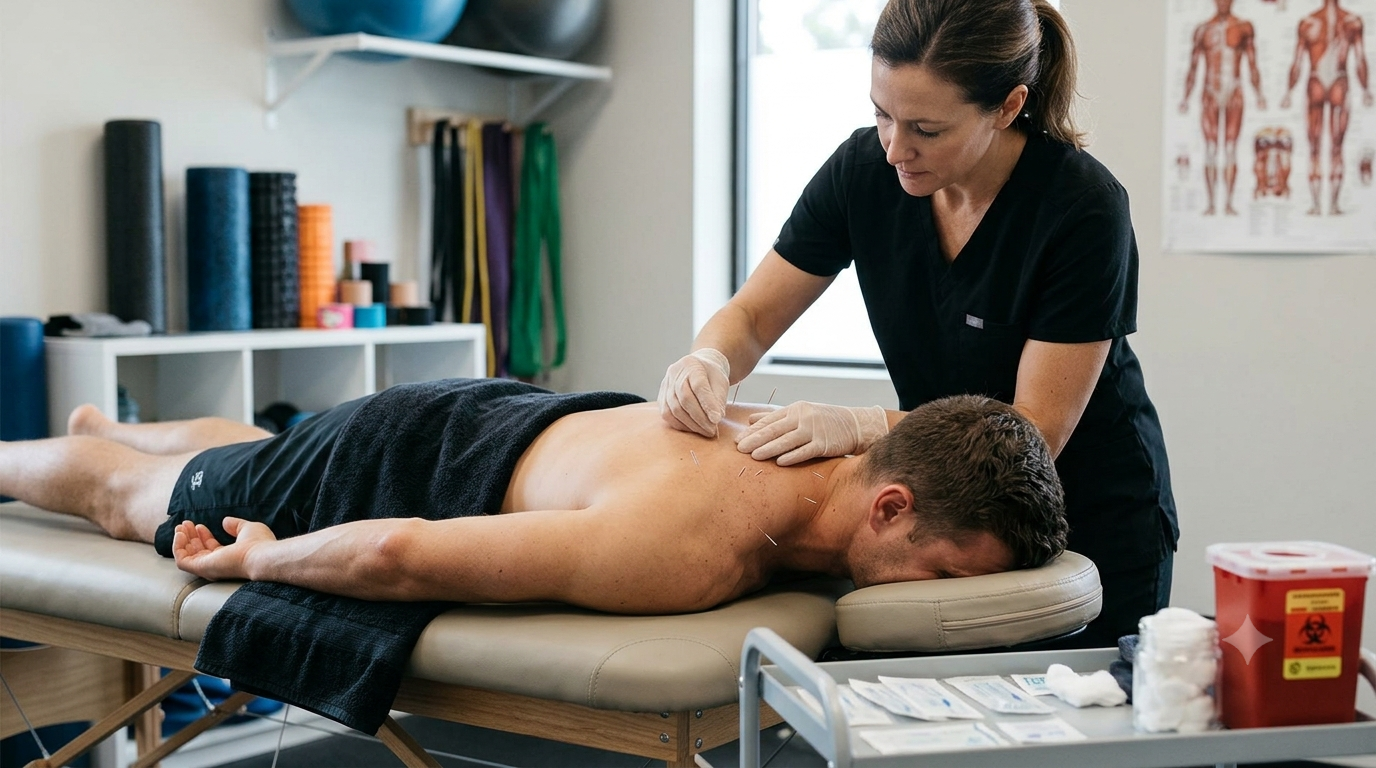
Some athletes ask about acupuncture as an additional option for managing musculoskeletal discomfort. When considering acupuncture for sports injuries, keep the purpose clear: it may be discussed as a complementary approach for symptom management, but it does not establish what structure is injured or whether that structure has healed.
Research into acupuncture and related needling approaches in sports medicine is developing. A 2026 systematic review of Western medical acupuncture techniques reported possible pain improvements in athletes, but the evidence base was small and varied. The certainty of evidence differed according to the intervention and whether it was combined with physiotherapy or exercise.
This does not prove that acupuncture repairs damaged tissue, restores ligament stability, prevents reinjury, or shortens the time needed before returning to sport. Those decisions require appropriate clinical assessment and functional rehabilitation.
A responsible practitioner should ask what diagnosis has been made, what advice you have received, and whether any movements or treatments have been restricted. They should not encourage you to ignore pain or train through a suspected injury.
An athlete may feel less discomfort and still lack the strength, control, balance, or confidence required for competition. Pain is only one part of recovery.
For example, a player with a knee injury may report less pain during ordinary walking but still struggle with single-leg landing or changing direction. A runner with a calf problem may manage a short jog but experience symptoms when speed increases.
Return-to-sport decisions should consider the demands of the activity. Depending on the injury, a clinician or physiotherapist may assess:
Range of motion.
Strength and endurance.
Balance and coordination.
Running, jumping, or landing ability.
Sport-specific movements.
Confidence and response to progressively harder training.
Do not use a pain-free acupuncture session as a clearance test. The decision to return to full sport should follow the relevant clinical and rehabilitation guidance.
Example 1: Soreness after a new strength workout
A recreational athlete tries a new lower-body strength programme. The next day, both thighs feel stiff and tender, especially when walking downstairs. There was no sudden painful event, major swelling, or loss of function. The athlete reduces strenuous activity temporarily and monitors whether the discomfort improves. If symptoms become severe, unusual, or persistent, they seek professional advice.
Example 2: Sudden pain during a football match
A player feels a sharp pain around the ankle after landing awkwardly. The area begins to swell, and putting weight on the foot is difficult. The player stops playing and seeks assessment rather than booking a routine recovery session or trying to finish the match.
The first situation may be consistent with post-exercise soreness. The second raises concern for an injury that needs examination. The distinction should be made carefully, not by guessing.
Priya increases her running distance and adds hill sessions in the same week. After one workout, she notices soreness in both legs. A few days later, however, one ankle becomes more painful and begins to swell after a run.
Rather than assuming that all the discomfort is ordinary training soreness, Priya stops running and arranges an assessment. She receives advice about the injury and a plan for gradually rebuilding activity. She asks whether complementary treatment might be appropriate, but understands that it cannot determine when the ankle is ready for running again.
Priya uses the clinical plan to guide her return and does not rely on a temporary reduction in discomfort as proof that the injury has healed.
The transferable lesson is to pay attention when symptoms change in location, intensity, or effect on function. A new pattern deserves a fresh assessment.
|
Ask yourself |
If the answer is yes |
Recommended priority |
|
Did the pain begin suddenly during sport? |
A specific injury may have occurred |
Stop and assess the injury |
|
Is there substantial swelling or bruising? |
A more significant injury may be present |
Seek medical advice |
|
Can you bear weight and move normally? |
Difficulty may indicate a problem needing assessment |
Do not return to sport without guidance |
|
Is there numbness or weakness? |
Neurological involvement may need urgent review |
Seek urgent medical assessment |
|
Has a clinician assessed the injury? |
You may have a clearer diagnosis and plan |
Discuss optional adjuncts within that plan |
|
Is the main goal to return to competition quickly? |
Rushing may increase risk |
Follow functional return-to-sport criteria |
Post-exercise soreness and sports injuries can overlap, but they are not interchangeable. Sudden pain, significant swelling, difficulty bearing weight, weakness, or persistent symptoms should not be dismissed as ordinary training discomfort.
If you are exploring acupuncture for sports injuries, first make sure the injury has been appropriately assessed. Consider complementary treatment only as an optional part of a wider plan, and keep rehabilitation and return-to-sport decisions guided by qualified healthcare professionals.
For more information about the services offered by Swiss Acupuncture, visit the clinic's website and discuss your diagnosis, symptoms, and current rehabilitation plan before arranging a session.
Soreness often develops gradually after exercise and affects the muscles that were worked. An injury may involve sudden pain, swelling, bruising, instability, or reduced function. These patterns are not definitive, so seek assessment if you are unsure.
That depends on the severity and pattern of symptoms. Avoid strenuous activity if movement is significantly affected or pain is worsening. Seek professional advice if symptoms are unusual or persistent.
Some research suggests possible pain-related benefits, but the evidence is still developing. It should be considered only as a possible adjunct and not a replacement for diagnosis or rehabilitation.
It should not be presented as a way to repair a torn ligament or restore mechanical stability. A significant ligament injury needs appropriate assessment and a rehabilitation plan.
Seek urgent assessment for severe pain, major swelling, deformity, inability to bear weight, new numbness, weakness, or other serious symptoms.
No. Return-to-sport decisions also depend on strength, movement, balance, sport-specific function, and clinical guidance. Pain relief alone is not clearance to compete.