Indonesia
 English
 Arabic
 French
 Spanish
 Portuguese
 Deutsch
 Turkish
 Dutch
 Italiano
 Russian
 Romaian
 Portuguese (Brazil)
 Greek
Riyadh to Makkah and Madina to Makkah: Your Complete Travel Guide for Umrah
Other |
2026-11-27 16:32:34
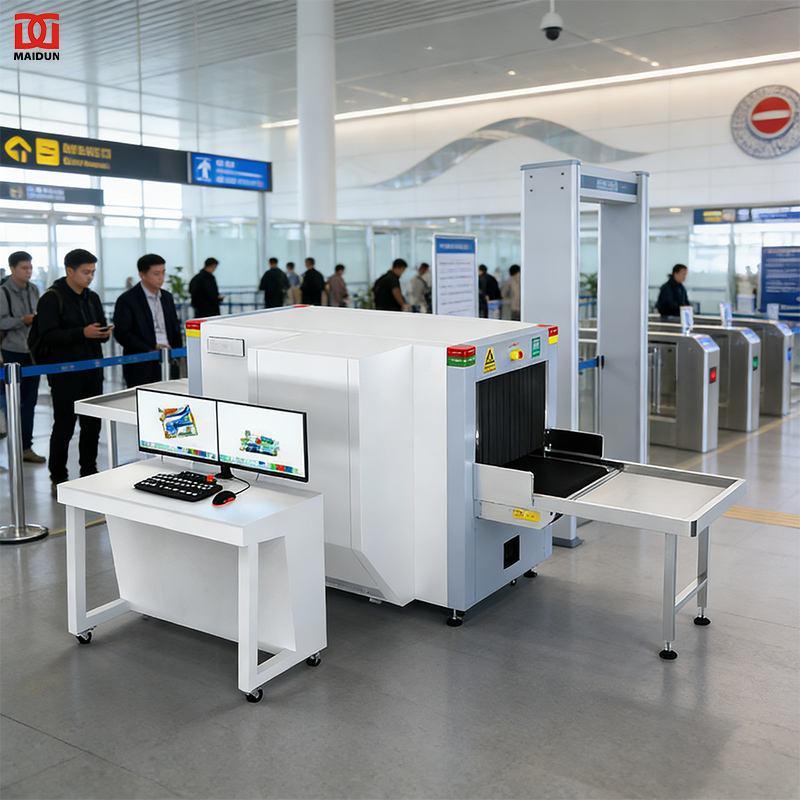
Security has become an essential priority for airports, railway stations, government buildings, industrial facilities, commercial establishments, and other sensitive locations. As security requirements evolve, organisations increasingly depend on modern inspection technologies to identify potential threats, examine baggage, and protect people and infrastructure.
Traditional security procedures often combine manual inspection with electronic screening equipment. However, advanced technologies now provide additional capabilities for identifying suspicious materials, examining concealed objects, and inspecting industrial components without damaging them.
Among these technologies, explosive detection equipment and X-ray inspection systems play important but different roles. While explosive detectors help identify specific explosive substances or their traces, X-ray scanners provide images of objects concealed inside bags, parcels, and other inspected items.
Understanding these technologies can help organisations select appropriate security equipment for their operational requirements.
Explosive detection is an important component of modern security screening. Airports, government facilities, transportation hubs, and critical infrastructure may require specialised equipment to identify potential explosive threats.
Explosive detectors are devices designed to identify the presence of specified explosive substances. Depending on the technology, they may examine trace particles collected from surfaces, analyse samples, or use other detection methods.
These systems can support security personnel during passenger screening, baggage inspection, access control, and specialised field operations.
1. Explosive Trace Detection (ETD)
Explosive trace detection equipment analyses samples collected from surfaces using suitable sampling methods. The collected sample is examined by the detector to identify traces associated with supported explosive substances.
These systems are commonly used in security environments where additional examination of baggage, personal belongings, or other surfaces is required.
2. Handheld explosive detection devices
Portable detectors are designed for security personnel who need equipment that can be carried between inspection locations.
Their portability makes them useful for selected field operations, checkpoints, and security assessments where fixed screening equipment may not be practical.
3. Automated explosive detection systems
Certain advanced baggage screening systems use specialised imaging technology and detection algorithms to automatically assess inspected items for specified explosive threats.
For example, some computed tomography (CT)-based airport systems are designed to perform automated explosive detection within checked-baggage screening workflows.
It is important to distinguish these systems from trace detectors because their detection methods and operating procedures are different.
Security requirements differ between locations. An airport checkpoint, industrial facility, railway station, and government building may each face different inspection challenges.
Selecting suitable equipment helps organisations establish screening procedures that match their environment.
Advanced detection equipment provides additional information that can help security personnel investigate suspicious items and make informed decisions.
Depending on the system, this may involve chemical or trace analysis, X-ray imaging, automated alerts, or specialised inspection software.
Modern inspection equipment can assist trained personnel by providing analytical information and visual inspection capabilities.
However, equipment should be used alongside appropriate training, operating procedures, and secondary inspection processes.
Different facilities require different equipment configurations.
Portable explosive detectors may suit mobile inspection requirements, while fixed X-ray baggage scanners are more appropriate for designated screening checkpoints.
Detection equipment can be incorporated into broader security arrangements involving access control, manual inspection, baggage screening, monitoring, and incident-response procedures.
The equipment should be selected according to the facility's risk assessment and applicable regulatory requirements.
X-ray technology is widely used for inspecting baggage, parcels, and other objects without opening them.
An X-ray scanner passes radiation through an inspected item and captures the resulting information using detector technology. Software processes this information to create an image that trained operators can examine.
Depending on the system, imaging features may include material discrimination, image enhancement, multiple colour displays, and automated threat alerts.
X-ray baggage inspection is particularly useful in environments where large numbers of personal belongings and packages must be examined.
Airports and aviation facilities
Railway and metro stations
Government buildings
Corporate offices
Hotels and commercial properties
Customs and logistics facilities
Industrial manufacturing environments
The requirements of security screening and industrial non-destructive testing are different. A baggage scanner is designed to inspect luggage and parcels, whereas industrial X-ray equipment is used to examine internal features and defects in manufactured components.
Not every security checkpoint requires a large industrial inspection system. Smaller facilities often need compact equipment that can fit into restricted spaces while providing suitable baggage-screening capabilities.
A small size xray baggage scanner is designed for inspecting hand luggage, small bags, parcels, and personal belongings.
These systems are particularly relevant for locations such as:
Corporate office entrances
Hotel reception and access points
Shopping centres
Educational institutions
Railway and metro stations
Government offices
Small security checkpoints
Space-saving installation: Compact scanners can be suitable for locations where larger inspection systems cannot be accommodated.
Convenient baggage handling: Their smaller dimensions can support screening arrangements for personal belongings and smaller parcels.
Image-based inspection: Operators can examine the contents of scanned items using the available imaging and image-processing features.
Flexible applications: Compact systems can support different controlled-entry environments depending on tunnel dimensions and equipment specifications.
Operational convenience: Suitable conveyor and operator arrangements can help integrate scanning into everyday access-control procedures.
When choosing a compact scanner, organisations should evaluate tunnel size, image quality, conveyor capacity, radiation safety, maintenance, and the features available on the specific model.
Industrial X-ray inspection serves a different purpose from conventional baggage screening.
Manufacturers use X-ray imaging to examine the internal structure of components without physically cutting or damaging them. This process is commonly known as non-destructive testing (NDT).
It can help identify internal defects, inconsistencies, and structural issues that may not be visible during ordinary external inspection.
Automotive manufacturing: X-ray inspection can help examine castings, metal components, and assemblies for internal defects.
Aerospace engineering: Specialised inspection systems can support the examination of critical components where internal quality is important.
Electronics manufacturing: X-ray imaging can help inspect solder joints, connectors, and internal electronic assemblies.
Metal casting: Manufacturers can use radiographic inspection to examine cast products for internal discontinuities.
Research and development: Advanced imaging systems can support component analysis and material research.
Industrial systems may offer 2D radiography, computed tomography, automated positioning, and other features depending on their design.
Organisations evaluating industrial x ray scanners manufacturers should consider more than the initial equipment price.
The appropriate inspection system depends on the size, material, complexity, and expected inspection volume of the components being examined.
Important factors include:
Imaging resolution: The system should provide sufficient image detail for the intended inspection task.
X-ray source capability: Generator specifications should match the materials, component thicknesses, and penetration requirements.
Detector technology: Detector quality affects the information available for image analysis.
Inspection volume: The system should accommodate the size and number of components that need to be examined.
Automation: Multi-axis manipulators and automated positioning can support repeatable inspection workflows where required.
Safety: Equipment should incorporate appropriate radiation shielding, safety interlocks, and compliance documentation.
Technical support: Maintenance, operator training, spare parts, and long-term service availability should be evaluated.
A detailed technical assessment and demonstration can help buyers identify a suitable configuration.
Krystalvision Image Systems Pvt. Ltd. is an Indian manufacturer of X-ray inspection and security-screening equipment.
Its product portfolio includes explosive threat detection devices, baggage scanners, and industrial X-ray inspection systems.
The company's product range addresses different inspection requirements across security, manufacturing, and non-destructive testing applications.
Krystalvision's ED Series includes the KV OPX Revelator, a handheld explosive detection device developed in collaboration with HEMRL, DRDO.
According to the manufacturer's product information, the device supports identification of explosives in pure form and traces. Its features include portability, a rechargeable battery, an expandable library, and real-time threat detection.
The product is intended for applications involving security agencies and field inspection requirements.
Learn more about Krystalvision explosive threat detection equipment.
The KVC Series is designed for industrial inspection and non-destructive testing applications.
Depending on the model, these systems support 2D radiography and optional 3D computed tomography imaging.
Applications include automotive components, aerospace parts, electronics, scientific research, and other industrial inspection requirements.
Features across the product range include high-resolution detectors, enclosed cabinet designs, and automated multi-axis inspection capabilities on selected models.
Explore Krystalvision advanced industrial X-ray solutions.
The KV 5 Series is designed for compact baggage and parcel inspection.
According to the manufacturer, these systems feature tunnel widths in the 50–60 cm range and are intended for locations with limited installation space.
Applications include mailrooms, corporate offices, malls, and other controlled-entry environments.
Explore the small-size X-ray baggage scanner range.
Before purchasing any inspection system, organisations should clearly identify the problem they need to solve.
A trace detector, an X-ray baggage scanner, and an industrial NDT system are not interchangeable products.
The following considerations can help guide procurement decisions.
Identify the inspection objective: Determine whether the requirement involves explosive trace detection, baggage imaging, industrial component inspection, or a combination of these applications.
Evaluate the operating environment: Consider available space, expected inspection volume, environmental conditions, and whether the equipment will be permanently installed or used in the field.
Check technical specifications: Review detection capabilities, tunnel dimensions, imaging resolution, operating time, power requirements, and supported applications.
Verify compliance: Confirm applicable safety requirements, product documentation, certifications, and approvals for the intended jurisdiction and application.
Consider training and maintenance: Operators should receive appropriate training, while equipment should have suitable technical support and preventive maintenance arrangements.
Request a product demonstration: A practical demonstration can help buyers understand the equipment's capabilities and determine whether it meets their actual requirements.
Security and industrial inspection technologies continue to evolve through advances in imaging, analytical software, automation, and portable detection equipment.
Modern facilities increasingly need inspection arrangements that can adapt to different operational environments.
Portable detection devices can provide flexibility for field-based security operations. Compact baggage scanners can support access-control checkpoints, while advanced industrial X-ray systems can help manufacturers examine complex components without damaging them.
The future of inspection will depend not only on improved equipment but also on effective implementation, trained personnel, appropriate maintenance, and compliance with relevant standards.
Organisations that understand the differences between available technologies will be better positioned to make informed equipment investments.
Modern inspection technology plays an important role in protecting facilities, supporting security personnel, and maintaining product quality across industrial applications.
Explosive detectors, baggage X-ray scanners, and industrial non-destructive testing systems address different requirements, but all contribute to more informed inspection processes.
Selecting the right equipment requires understanding the intended application, technical capabilities, operating environment, and applicable safety requirements.
Krystalvision offers solutions across explosive threat detection, compact baggage screening, and advanced industrial X-ray inspection. Organisations can explore these product categories to identify equipment suited to their security and inspection objectives.