Indonesia
 English
 Arabic
 French
 Spanish
 Portuguese
 Deutsch
 Turkish
 Dutch
 Italiano
 Russian
 Romaian
 Portuguese (Brazil)
 Greek
Degree Through ACCA | Wisdom Business Academy
Home |
2026-11-25 13:28:21
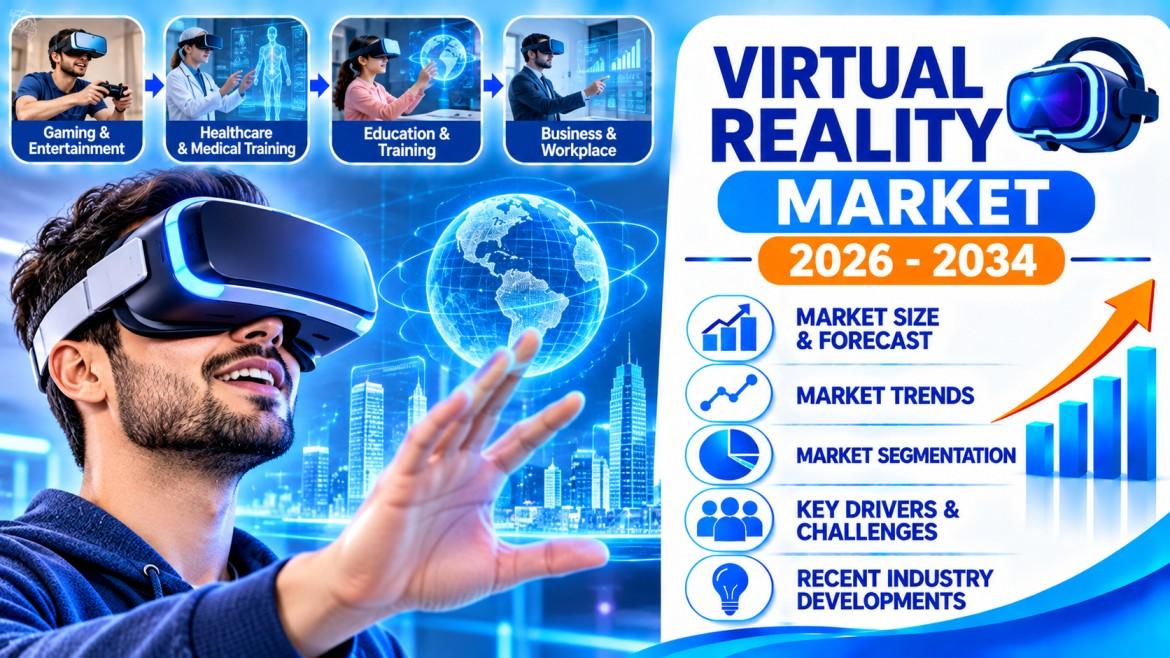
IMARC Group, a leading global market research and management consulting firm, has published its latest market intelligence report on the virtual reality market. The global virtual reality market grew from USD 19.3 Billion in 2025 to USD 23.2 Billion in 2026. Looking forward, IMARC Group estimates the market to reach USD 100.2 Billion by 2034, exhibiting a CAGR of 20.08% from 2026-2034, driven by rising adoption of immersive training and simulation across enterprises, expanding use of virtual reality in healthcare therapy and surgical education, growing demand for immersive gaming and entertainment, and the arrival of more affordable, higher-resolution headsets supported by 5G and artificial intelligence.
The virtual reality market is experiencing strong growth momentum as immersive technology moves from a niche gaming accessory to a practical tool for business, medicine, education, and retail. Enterprises are using virtual environments to train employees in construction, automotive, aviation, and healthcare settings without the cost and risk of physical simulation. Hospitals are deploying virtual reality for surgical rehearsal, pain management, exposure therapy, and rehabilitation. Consumers, meanwhile, are gaining access to lighter and more powerful headsets, which is widening the audience for gaming, live sports, concerts, and virtual property tours.
Grab a sample PDF of this report: https://www.imarcgroup.com/virtual-reality-market/requestsample
The global virtual reality market is witnessing steady expansion, fueled by the convergence of better hardware, stronger connectivity, and a widening set of commercial applications. Immersive gaming and entertainment remain the most visible demand engine, with major gaming companies integrating virtual reality into their titles and sports, concerts, and film increasingly delivered in immersive formats. Sports-themed experiences such as Rezzil's Premier League Player game for Meta Quest show how licensed content is bringing new audiences into virtual reality.
Healthcare is emerging as one of the most consequential growth areas. Virtual reality is being applied to surgical training, anxiety and phobia treatment, mental health therapy, and physical rehabilitation. In the United States, the Department of Defense has awarded USD 1.5 million to the University of Arizona for a portable virtual reality device that supports assessment of traumatic brain injury, and USD 5.7 million to Indiana University for a virtual reality civics tool called Democracy Quest. In India, Wundrsight secured USD 400,000 from Inflection Point Ventures to scale virtual reality mental health offerings, a sign of rising private investment in therapeutic applications.
Enterprise adoption is equally important. Companies are using virtual reality for employee training, product design, simulation, and remote collaboration, a shift that gained momentum during the pandemic and has since become a durable operating practice. Sandals Corporate University, for example, launched an extended reality training platform with EON Reality to upskill hospitality staff. In retail, Alo Yoga introduced a virtual reality shopping experience with Obsess on Meta Quest 2, illustrating how brands are using immersive storefronts for product visualization and customer engagement. Real estate firms are likewise offering virtual property tours that reduce the need for physical site visits.
Connectivity and policy support are strengthening the foundation. The US Federal Communications Commission granted Apple, Meta, and Google access to 6GHz spectrum for low-power mobile virtual reality and augmented reality devices, improving the performance of wireless headsets. The virtual reality industry contributed over USD 5 billion to the US economy, according to the Bureau of Economic Analysis. The European Commission committed EUR 1.5 million (USD 1.59 million) to virtual reality and augmented reality development, while Brazil received about BRL 1.2 billion (USD 237.6 million) through its national science and technology fund FNDCT, which supports initiatives including virtual reality. In the Middle East, the UAE's national artificial intelligence strategy targets AED 335 billion (USD 91.21 billion) in economic growth, creating a favorable backdrop for immersive technology adoption.
Ask an analyst for customized report: https://www.imarcgroup.com/request?type=report&id=3729&flag=E
The report has segmented the market into the following categories:
Head-mounted displays account for the largest device type share, driven by their role as the primary gateway to immersive experiences across gaming, training, healthcare, and design. Continuous improvements in display resolution, field of view, processing power, and wireless freedom are making headsets more comfortable and more capable for both consumers and enterprises.
Semi and fully immersive technology leads the market, as users and organizations seek realistic, high-fidelity environments for simulation, therapy, collaborative design, and entertainment where presence and interaction quality directly affect outcomes.
Hardware represents the largest component segment, supported by strong demand for headsets, sensors, controllers, and tracking systems, while software and content platforms continue to grow as developers build applications for enterprise, healthcare, and consumer use.
The commercial application segment holds the largest share, reflecting widespread use of virtual reality in retail, real estate, hospitality, education, and entertainment venues, where immersive experiences improve customer engagement and shorten decision cycles.
North America dominates the global virtual reality market with a share of over 37%, supported by a strong technology ecosystem, significant government and defense funding for immersive research, a concentration of leading headset and software developers, and early enterprise and consumer adoption. Asia Pacific is also gaining ground as entertainment, healthcare, and industrial users expand deployments. For instance, iQIYI is rolling out virtual reality location-based entertainment in Chinese cities with plans to extend to Dubai and Bangkok.
The report provides a comprehensive analysis of the competitive landscape in the virtual reality market with detailed profiles of all major companies, including:
If you are tracking the virtual reality market for investment decisions, market entry planning, competitive benchmarking, or strategic advisory, IMARC Group's report gives you everything in one place:
Note: If you require specific details, data, or insights that are not currently included in the scope of this report, IMARC Group offers customization services to gather and provide the additional information you need, tailored to your specific requirements.
IMARC Group is a global management consulting firm that helps the world's most ambitious changemakers to create a lasting impact. The company provides a comprehensive suite of market entry and expansion services. IMARC offerings include thorough market assessment, feasibility studies, company incorporation assistance, factory setup support, regulatory approvals and licensing navigation, branding, marketing and sales strategies, competitive landscape and benchmarking analyses, pricing and cost research, and procurement research.
IMARC Group
Email: sales@imarcgroup.com
United States: +1-201-971-6302
India: +91-120-433-0800
United Kingdom: +44-753-714-6104