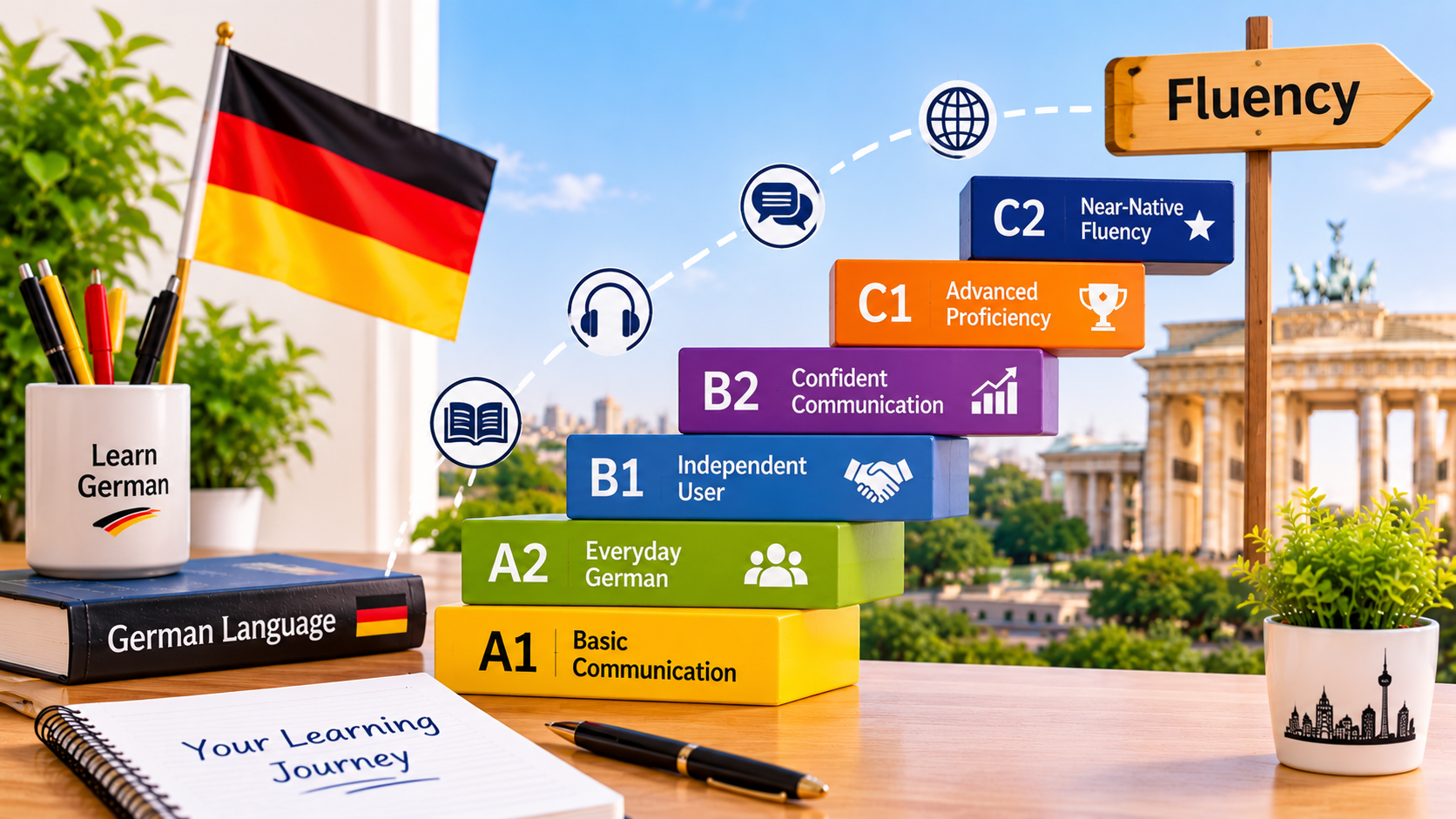
Learning German is a gradual process where every stage changes the way you use the language. At first, you may only understand greetings or introduce yourself, but later you can discuss experiences, explain opinions, and understand more detailed conversations.
German Language Levels give learners a progression to follow, helping them understand what they can do today and which skills they need to develop next.
Instead of measuring progress by the number of words memorised, learners can use each level to recognise practical abilities, identify weak areas, and prepare for more demanding communication.
Your First Level Changes How You Approach German
At the beginning, German may feel unfamiliar because even simple sentences contain new sounds, word forms, and grammatical patterns. The first stage helps learners become comfortable with the language without expecting them to understand everything immediately.
Early learning usually involves introducing yourself, asking basic questions, recognising familiar words, and forming short sentences. These tasks may appear simple, but they create the foundation for more complicated communication.
The important change at this stage is moving from recognising isolated words to understanding how they work together in a sentence.
A1 Teaches You to Handle Small Everyday Situations
At A1, learners begin using German in familiar situations rather than only studying it from a textbook. They can work towards introducing themselves, sharing basic information, asking simple questions, and understanding common expressions.
Imagine visiting a German-speaking place for the first time. You may need to say your name, ask for a price, understand a time, or order something. A1 prepares you to manage these basic exchanges with simple language.
Your progress at this stage can be measured through small tasks. Can you introduce yourself without reading? Can you understand a basic question? Can you write a few sentences about yourself? These abilities show that your foundation is developing.
A2 Makes Familiar Conversations Easier to Manage
At A2, communication begins to move beyond short introductions. Learners work with everyday situations involving shopping, travel, family, routines, appointments, and familiar activities.
You may begin to understand short conversations without needing every word translated. You can describe your routine, ask for information, and respond to common questions with more flexibility.
This stage also teaches learners to combine ideas. Instead of producing only separate sentences, they start explaining simple details about what they do, where they go, or what they need.
Choosing the Best German Language Institute Near Me Can Support Your Progress
When searching for the
best German language institute near me, consider whether the teaching approach supports progression through the levels rather than focusing only on completing chapters. A suitable learning environment should help you practise the skills expected at your current stage and prepare you for the next one.
Ask how teachers evaluate progress, whether speaking activities are included, and how students receive feedback on recurring mistakes. Check if the programme follows clear level-based objectives and gives learners opportunities to apply grammar and vocabulary in practical situations.
The right learning environment should make your progress measurable through actual language abilities, not just the number of lessons completed.
B1 Helps You Express Ideas Instead of Just Giving Short Answers
B1 is an important transition because learners begin handling conversations with greater independence. They can work towards discussing familiar topics, describing personal experiences, explaining plans, and expressing opinions with reasons.
For example, an A2 learner might say they enjoy travelling. At B1, they can explain where they travelled, what they experienced, what they liked, and why they would visit again.
At this stage, communication becomes less dependent on memorised sentences. Learners need to connect ideas, understand the main points of clear conversations, and find ways to continue speaking even when they do not know a particular word.
B2 Develops More Detailed Communication
At B2, learners are expected to deal with a wider range of topics and more complex language. They can work towards understanding longer texts, participating in discussions, and explaining viewpoints in greater detail.
This level can be particularly relevant for students preparing for German-taught higher education, professional environments, or situations requiring stronger communication skills. However, specific university or workplace requirements can differ, so learners should check the qualifications expected for their goals.
The shift at B2 is not simply using more vocabulary. It involves understanding context, responding with appropriate detail, and expressing ideas with greater clarity.
C1 Changes the Way You Use German in Academic and Professional Settings
C1 involves advanced language abilities. Learners work towards understanding demanding texts, recognising implied meaning, expressing themselves fluently, and adapting language to different situations.
At this stage, German may be used for academic discussions, presentations, detailed written work, professional communication, and topics that require careful explanation.
Students progressing towards C1 often need to focus on more than grammar accuracy. They also need to organise arguments, understand complex information, choose suitable expressions, and communicate ideas in a natural and precise way.
C2 Focuses on Precision, Nuance, and Flexibility
C2 is the highest CEFR proficiency level. It describes the ability to understand virtually everything heard or read and communicate with a high degree of precision and flexibility.
Learners at this stage work with subtle differences in meaning, complex discussions, detailed writing, and language used in different contexts. They can express ideas carefully and understand nuances that may be missed at lower levels.
C2 does not mean that a person will never make mistakes. Language is constantly changing, and specialised vocabulary can still require learning. The level describes a very advanced ability to use and understand the language.
Each Level Requires a Different Kind of Practice
Repeating the same study routine throughout your entire learning journey may not be enough. Your practice should change as your ability develops.
| |
|
| A1 |
Introductions, basic vocabulary, simple questions |
| A2 |
Everyday dialogues, short messages, routine situations |
| B1 |
Opinions, experiences, connected speaking and writing |
| B2 |
Longer discussions, detailed reading, structured arguments |
| C1 |
Academic texts, presentations, complex communication |
| C2 |
Nuanced expression, precision, advanced comprehension |
A learner at A1 may benefit from repeating basic conversations, while a B2 learner needs more demanding discussions and longer texts. Choosing practice that matches your level helps you work on skills that are challenging without being overwhelming.
Use Your Current Ability to Decide What Comes Next
Progress is easier to plan when you can identify what you already do well and what still causes difficulty. Instead of automatically moving to the next course, check whether you can use your current level's skills comfortably.
Ask yourself:
- Can I understand the main message without translating every sentence?
- Can I speak about familiar topics without relying on memorised answers?
- Can I write a message appropriate to my level?
- Can I follow a conversation when the other person speaks clearly?
- Which grammar or vocabulary topics still create confusion?
Your answers can help you decide whether you need more practice, revision, or a higher-level course. A realistic assessment makes the next step more meaningful.
Frequently Asked Questions
How many German language levels are there?
The CEFR framework includes six levels: A1, A2, B1, B2, C1, and C2. They progress from basic communication to advanced language proficiency.
Which German level is considered intermediate?
B1 and B2 are generally classified as intermediate stages. B1 focuses on independent communication in familiar situations, while B2 supports more detailed and complex communication.
Can I move from A1 to B1 without completing A2?
Your progression depends on your actual language ability and the course requirements. A learner must develop the skills associated with A2 before being ready for B1, even if the learning route or course arrangement differs.
Which level should I choose if I already know some German?
A placement assessment can help identify your current ability. Your knowledge of grammar, vocabulary, listening, speaking, reading, and writing should be considered rather than relying only on how long you have studied.
Conclusion
German learning becomes easier to organise when every level has a clear purpose. A1 introduces basic communication, A2 expands everyday interaction, B1 develops independence, B2 strengthens detailed communication, and C1 and C2 build advanced language abilities. Understanding this progression helps learners recognise their achievements, identify the skills they still need, and choose the next stage based on their actual proficiency rather than guesswork.
 Indonesia
 English
 Arabic
 French
 Spanish
 Portuguese
 Deutsch
 Turkish
 Dutch
 Italiano
 Russian
 Romaian
 Portuguese (Brazil)
 Greek