Indonesia
 English
 Arabic
 French
 Spanish
 Portuguese
 Deutsch
 Turkish
 Dutch
 Italiano
 Russian
 Romaian
 Portuguese (Brazil)
 Greek
What Is the Recovery Process After Under Eye Fillers?
Health |
2026-10-20 11:52:37
Businesses are increasingly exploring artificial intelligence to automate operations, improve customer experiences, and manage complex workflows. AI agents are becoming an important part of this transformation because they can understand instructions, retrieve information, interact with connected applications, and perform tasks within defined permissions.
However, building a reliable AI agent requires more than choosing an AI model or integrating a chatbot. Businesses need technical expertise, suitable architecture, secure integrations, and a development process that aligns with their operational objectives.
This makes selecting the right AI Agent Development Company an important decision.
Whether you want to automate customer support, streamline sales operations, develop an internal AI assistant, or build an enterprise multi-agent system, your development partner should understand both your business requirements and technical expectations.
In this guide, we explain what an AI Agent Development Company does and how to choose the right partner for your business.
An AI Agent Development Company specializes in designing, building, integrating, testing, and deploying AI-powered agents for different business applications.
These companies combine AI models, software engineering, data processing, APIs, and automation technologies to develop agents that can perform specific tasks.
Depending on the project requirements, an AI agent development team may work on:
Custom AI agent development
Conversational AI agent development
Enterprise AI agent development
Multi-agent system development
AI workflow automation
AI agent integration
AI agent testing and optimization
The objective is to create AI agents that support business processes and interact with existing applications while following defined instructions, permissions, and security requirements.
Off-the-shelf AI tools may be suitable for basic tasks, but businesses with specialized workflows often require customized functionality.
An experienced AI Agent Development Company can help organizations understand their requirements and build solutions around their existing technology environment.
For example, a company may need an AI agent that retrieves customer records from its CRM, checks order information from an ERP system, and prepares a support response.
Developing this solution requires workflow planning, API integration, access management, testing, and ongoing monitoring.
A development partner can coordinate these technical requirements and help businesses move from an initial idea to a functional AI application.
Before selecting a development partner, understand the range of services it can provide.
Custom AI Agent Development focuses on creating agents based on specific business processes and operational requirements.
These agents can be designed to perform tasks such as customer assistance, information retrieval, lead management, document processing, and internal workflow automation.
The functionality, architecture, and integrations depend on the intended application.
Conversational AI agents allow customers and employees to interact with AI systems using natural language.
They can support website assistance, customer service, internal knowledge access, and other communication requirements.
With suitable integrations, these agents can retrieve information from approved business sources and assist with connected workflows.
Enterprise AI Agent Development focuses on creating AI systems for larger and more complex business environments.
These solutions may require integration with multiple enterprise applications, internal databases, document repositories, and operational platforms.
Access control, security, scalability, monitoring, and governance are important parts of enterprise implementations.
Multi-agent systems use multiple specialized agents to coordinate tasks within a larger workflow.
For example, one agent may collect information, another may validate it, and a third may generate a summary.
An orchestration mechanism manages communication and task execution between these agents.
AI agents often require access to existing business systems to perform meaningful tasks.
An AI agent development team can integrate agents with CRM platforms, ERP software, databases, APIs, and other applications.
These integrations help agents retrieve relevant data and perform approved actions within established business processes.
AI workflow automation focuses on coordinating repetitive tasks and multi-step business processes.
Examples include document review, lead processing, support ticket classification, information validation, and task assignment.
Businesses can use AI agents to handle suitable workflow steps while keeping human approval for sensitive or high-impact actions.
AI agent development continues after deployment.
Agents may need improvements as business requirements, connected applications, data sources, and AI models change.
Ongoing support can include performance monitoring, troubleshooting, workflow updates, testing, and optimization.
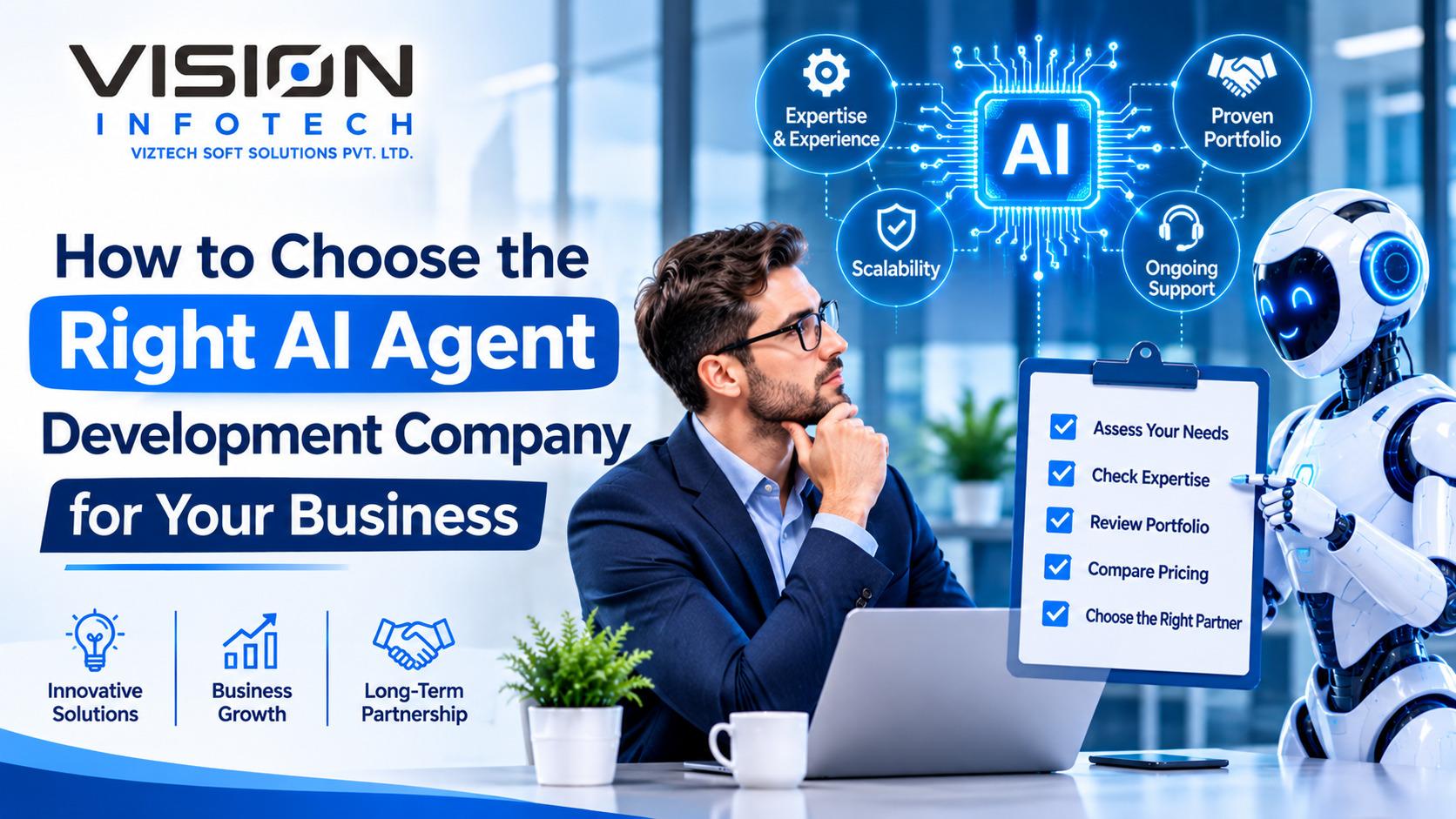
Selecting the right AI Agent Development Company requires evaluating more than its website, service list, or technology portfolio.
Here are ten important factors to consider.
Evaluate the company's understanding of AI models, agent architecture, machine learning, natural language processing, APIs, and automation technologies.
The development team should be able to explain why a particular technology is suitable for your project.
Every business has different workflows and technical requirements.
Ask whether the company can develop customized agents rather than relying entirely on prebuilt templates.
Discuss how it approaches specialized business logic, tool usage, knowledge retrieval, and workflow orchestration.
A reliable development partner should begin by understanding your operational challenges.
It should evaluate your current processes, identify suitable automation opportunities, and define measurable project objectives before recommending an AI solution.
Check whether the company can integrate AI agents with your existing business applications.
Relevant experience may include CRM systems, ERP platforms, databases, helpdesk applications, cloud environments, and third-party APIs.
Also discuss authentication, permissions, integration failures, and data synchronization.
AI agents may interact with confidential business information and customer data.
Ask about authentication, encryption, access restrictions, logging, data retention, and privacy controls.
The company should also understand the regulatory requirements applicable to your industry and deployment location.
A functional demonstration does not guarantee that an AI agent will perform reliably in real business environments.
Ask how the company tests response quality, workflow execution, tool usage, error handling, and security.
It should have a clear evaluation process before production deployment.
Not every action should be performed independently by an AI agent.
Ask how the company handles approval requirements, restricted actions, exception management, and escalation to human employees.
These controls are particularly important for financial, customer-facing, and sensitive operational workflows.
Your business requirements may change after the initial implementation.
Choose a development partner that considers future integrations, additional agents, increased usage, and evolving workflow requirements during architecture planning.
AI agents require ongoing monitoring and maintenance.
Understand whether the company provides technical support, performance evaluation, troubleshooting, updates, and optimization after deployment.
Before starting development, discuss the project scope, milestones, deliverables, estimated timeline, pricing structure, and responsibilities.
Clarify source code ownership, documentation, deployment access, and intellectual property terms.
Transparent communication helps avoid misunderstandings during development.
A professional AI Agent Development Company should follow a structured process to convert business requirements into a working solution.
The development team studies your business objectives, existing workflows, technical environment, and expected AI agent functionality.
The team defines the agent's responsibilities, AI model requirements, tools, integrations, data sources, and security boundaries.
Developers build the required AI agent functionality, configure its instructions, and implement the necessary workflow logic.
The AI agent is connected to relevant APIs, databases, CRM platforms, ERP systems, and approved knowledge sources.
The solution is evaluated for functionality, response quality, task completion, security, and error handling.
After testing and approval, the AI agent is deployed in the selected business environment.
The development team monitors performance and introduces improvements based on actual usage, feedback, and changing business requirements.
The cost of hiring an AI Agent Development Company depends on the complexity and scope of the project.
A basic AI agent designed for a limited workflow will have different requirements from a customized enterprise solution involving multiple agents and integrations.
Important cost considerations include:
Agent complexity: The number of tasks, decision points, and workflows affects development effort.
AI model selection: Model capabilities and usage requirements influence implementation and operating costs.
System integrations: Connecting multiple business applications may increase technical complexity.
Data preparation: Document processing, knowledge retrieval, and data management can add to project requirements.
Security requirements: Authentication, access control, testing, and compliance-related controls influence development scope.
Ongoing maintenance: Hosting, model usage, monitoring, and technical support contribute to long-term expenses.
Request a project estimate based on your actual requirements instead of comparing development companies only by their initial quotations.
Choosing a development partner is about finding a team that understands your business objectives and can translate them into practical AI solutions.
Vision Infotech provides AI agent development opportunities for businesses looking to explore custom AI-powered applications and workflow automation.
Its AI Agent Development Company offering can be considered by organizations evaluating custom AI agents, application integrations, and solutions designed around their operational needs.
Before starting a project, businesses should discuss their requirements, existing systems, desired functionality, and security expectations.
If your organization is planning to implement AI agents for customer support, sales, operations, or enterprise workflows, connect with Vision Infotech to discuss your project requirements and explore a suitable development approach.
Choosing the right AI Agent Development Company can influence how effectively your business adopts AI-powered automation.
Look beyond technology claims and evaluate the development team's technical expertise, custom development capabilities, integration experience, security practices, testing process, and post-deployment support.
A structured approach helps businesses build AI agents that address practical operational challenges rather than introducing unnecessary complexity.
Start with a clearly defined business requirement, evaluate the available development options, and select a partner that can support your AI agent project from planning through deployment and ongoing improvement.