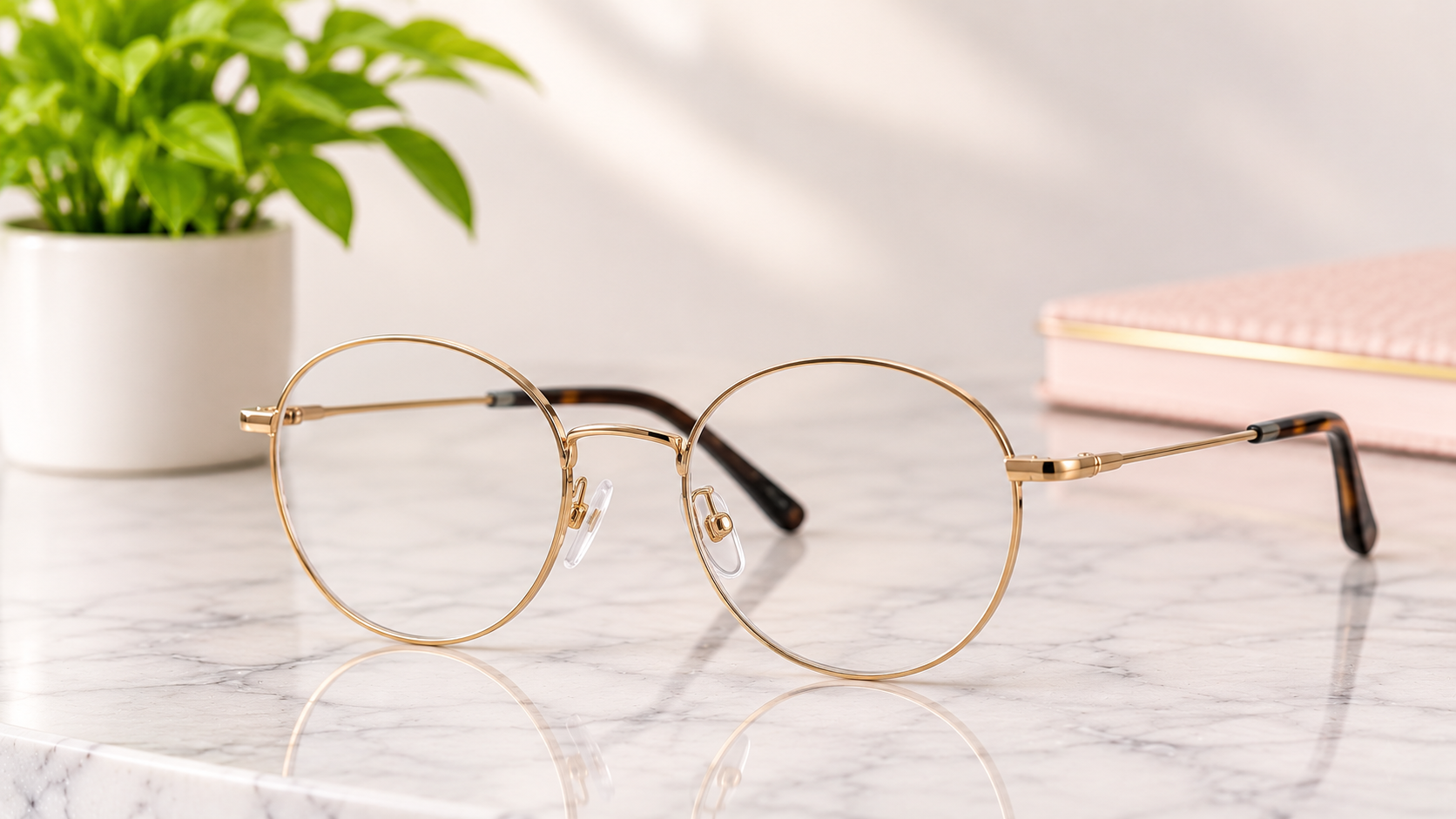
Round eyewear has a distinctive appearance because its curved lenses create a softer outline around the eyes. However, the right pair depends on more than personal taste. Facial proportions, lens diameter, bridge width, and frame position all influence how comfortably and naturally the glasses look.
What Makes Round Frames Different From Other Eyeglass Shapes?
Round frames use curved lens outlines instead of the straight edges found in rectangular and square designs. This gives them a recognisable appearance that can range from subtle and delicate to bold and noticeable.
Their construction can vary considerably:
- Thin metal rims: Create a light outline and leave more of the face visible.
- Thick acetate rims: Make the circular shape more prominent.
- Small circular lenses: Offer a compact, understated appearance.
- Large round lenses: Cover more of the area around the eyes.
- Semi-rimless designs: Reduce the visual weight around part of the lens.
The difference between these styles is not only decorative. Frame thickness and lens size can change how much attention the glasses draw to the eyes and surrounding features.
How Do Round Glasses Interact With Different Facial Proportions?
A face cannot always be described accurately through one category. Some girls have a narrow forehead with wider cheeks, while others have a broad upper face and a tapered chin. These differences influence how a circular frame appears.
For example, a small round frame may look proportionate on a narrow face but seem undersized on someone with broader facial features. A larger frame may create a stronger appearance, although excessive width can make the glasses look disconnected from the temples.
It is useful to consider the relationship between the forehead, cheekbones, and jaw rather than relying entirely on labels such as oval, round,d or heart-shaped.
Why Does Frame Diameter Matter for Smaller and Wider Faces?
Frame diameter refers to the size of the circular lens. It affects how much space the glasses occupy around the eyes and how prominent the frame appears.
Girls with smaller facial features may prefer a moderate lens diameter that does not cover too much of the cheeks. Wider faces may accommodate larger lenses, provided the overall frame width remains suitable.
When comparing different sizes, check these points:
- Whether the outer edges extend too far beyond the temples.
- Whether the lower rims touch the cheeks when smiling.
- Whether the lenses cover the required viewing area.
- Whether the frame looks balanced in relation to the forehead.
- Whether the glasses remain comfortable during normal movement.
A frame should be selected according to its actual measurements rather than its appearance in a product photograph.
Can Round Glasses Complement Square and Angular Faces?
Square and angular faces often have a defined jawline, broader forehead, and/or noticeable cheekbone structure. Curved eyewear adds a different outline around the eye, creating visual contrast with straighter facial features.
Round Glasses for Girls can therefore be an option for someone who prefers softer lines instead of repeating the angular appearance of their facial structure.
Frame size and thickness still matter. A very small circular design may look disconnected from a broad face, while an extremely thick rim can become the main feature of the appearance. Medium-sized frames with balanced proportions are worth comparing, particularly when the jawline is prominent.
What Should Girls With Round or Oval Faces Consider?
A round face generally has fuller cheeks and a softer jawline, while an oval face tends to have a longer outline with more balanced proportions. Circular glasses can create different effects on these two structures.
For a round face, some wearers may prefer frames with a slightly wider diameter or a defined upper rim. These details introduce variation without requiring a completely different lens shape. Girls with oval faces can compare several circular sizes, paying attention to how the lenses sit in relation to their cheekbones and eyebrows.
The most useful considerations include:
- The distance between the outer corners of the eyes.
- The width of the cheek area.
- The height of the lenses in relation to the eyebrows.
- The amount of space between the lower rim and cheeks.
These observations help narrow down suitable designs without treating face-shape categories as strict rules.
How Does Nose Shape Influence the Fit of Circular Eyeglasses?
The bridge is an important part of round glasses because it connects the lenses and supports the frame on the nose. If the bridge does not match the wearer's nose, the glasses may slide down, sit unevenly, or create pressure.
Different construction options can address different fitting needs. Adjustable nose pads allow some metal frames to be positioned more precisely, while acetate frames often use a fixed bridge. The choice should depend on the actual fit rather than the material alone.
A properly fitted pair should have these characteristics:
- The bridge rests comfortably without pinching.
- The lenses remain at a suitable height in front of the eyes.
- The frame does not repeatedly slide during normal activity.
- Pressure is not concentrated on one side of the nose.
- Both lenses sit evenly rather than tilting.
If the glasses continue to slip or leave marks, an optician can check whether adjustment or a different bridge measurement is needed.
How Do Round Frames Compare With Other Ladies' Eyewear Designs?
Circular glasses offer a different visual effect from rectangular, cat-eye, and geometric designs. Rectangular frames use more defined edges, while cat-eye styles have raised outer corners. Round designs rely on curved outlines and can appear delicate or bold depending on their dimensions. This is one reason
ladies' glasses frames are available in several shapes, materials, and sizes rather than following a single appearance.
Each design has its own characteristics:
- Round frames: Use curved outlines around both lenses.
- Rectangular frames: Create a more structured horizontal appearance.
- Cat-eye frames: Draw attention towards the outer corners.
- Geometric frames: Use angled edges for a more distinctive outline.
- Oval frames: Retain curved edges but have a longer horizontal shape.
Comparing these structures can help girls decide whether they prefer the softness of circular lenses or a design with more defined edges.
Which Frame Materials Are Suitable for Different Everyday Needs?
The material affects the weight, flexibility, and appearance of eyeglasses. Metal and acetate are common choices, but they do not feel or behave in exactly the same way.
Metal frames often have a slim profile and adjustable nose pads. Acetate frames can offer thicker rims and a wider range of colours and finishes. Some lightweight materials are also used for people who prefer glasses that feel less noticeable during long periods of wear.
Before choosing a material, consider:
- Daily wear: The frame should remain comfortable during extended use.
- Handling: Hinges and joints should feel secure.
- Skin contact: The material should be suitable for the wearer's needs.
- Maintenance: Some finishes require more careful cleaning than others.
- Prescription lenses: Confirm that the frame can accommodate the required lens type and prescription.
The best material is one that meets practical requirements as well as personal preferences.
How Can Colour and Clothing Choices Change the Look of Round Glasses?
The colour of a frame can influence its overall appearance. Black and dark brown create a defined outline, while transparent and light-coloured frames tend to appear less prominent. Gold and silver metal finishes offer another option for girls who prefer a simpler frame design.
Clothing can also influence how noticeable the glasses become. A bold circular frame may work well with plain outfits, while a subtle metal design can complement patterned clothing without competing for attention.
Some combinations to consider are:
- Dark acetate frames with neutral-coloured clothing.
- Gold metal frames with warm shades.
- Silver frames with cool-toned outfits.
- Transparent frames with colourful casual clothing.
- Tortoiseshell finishes with simple everyday styles.
These are styling suggestions rather than fixed rules. Personal preference and comfort should remain central to the choice.
What Should Be Checked Before Buying Round Prescription Glasses?
Appearance alone cannot confirm whether a pair of prescription glasses is suitable. The lens prescription, measurements, and position in front of the eyes all affect how the glasses perform.
Buyers should review the following details before placing an order:
- Prescription accuracy: Confirm that the lens power matches the current prescription.
- Pupillary distance: Ensure the optical centres are positioned correctly for the wearer.
- Lens height: Check that the lenses provide sufficient space for the required prescription.
- Frame measurements: Compare lens width, bridge width, and temple length.
- Construction: Inspect the hinges, rims and overall alignment.
- Professional fitting: Ask an optician to check the final fit and make suitable adjustments.
For stronger prescriptions, frame size and lens design can affect thickness and appearance. An optical professional can explain which options are appropriate for the individual prescription.
Frequently Asked Questions
1. Do round glasses suit girls with small faces?
Yes. Smaller or medium-sized circular frames may work well, provided their width and bridge measurements suit the face. Very large frames can cover too much of the surrounding facial area.
2. Are round glasses suitable for square faces?
They can be. Their curved outlines create contrast with the straighter features often associated with square faces. The frame's diameter and thickness should also be considered.
3. Are thin metal round glasses suitable for everyday use?
Thin metal frames can be suitable for regular wear if they fit securely and have durable construction. Their lightweight appearance may appeal to people who prefer less noticeable rims.
4. Can round glasses be used with prescription lenses?
Yes. Many round frames can accommodate prescription lenses, but suitability depends on the frame dimensions, lens type, and prescription strength. An optician can confirm compatibility.
5. How can girls prevent round glasses from slipping?
Slipping may result from an unsuitable bridge fit, loose hinges,s or incorrect temple adjustment. An optician can inspect the frame and make appropriate adjustments.
Conclusion
Round glasses can suit a range of facial structures, but their appearance depends on more than the shape of the lenses. Frame diameter, bridge construction, rim thickness, and positioning all contribute to the final fit. Girls with smaller features may prefer compact designs, while others may find larger circular frames more proportionate.
Comparing measurements, checking lens requirements, and trying different constructions can make the selection process more practical. The right pair should sit comfortably, support clear vision, and reflect the wearer's preferred style.
 Indonesia
 English
 Arabic
 French
 Spanish
 Portuguese
 Deutsch
 Turkish
 Dutch
 Italiano
 Russian
 Romaian
 Portuguese (Brazil)
 Greek