Indonesia
 English
 Arabic
 French
 Spanish
 Portuguese
 Deutsch
 Turkish
 Dutch
 Italiano
 Russian
 Romaian
 Portuguese (Brazil)
 Greek
Explore MMO Online Skills Resources for Better Gaming Performance
Games |
2026-10-19 06:04:01
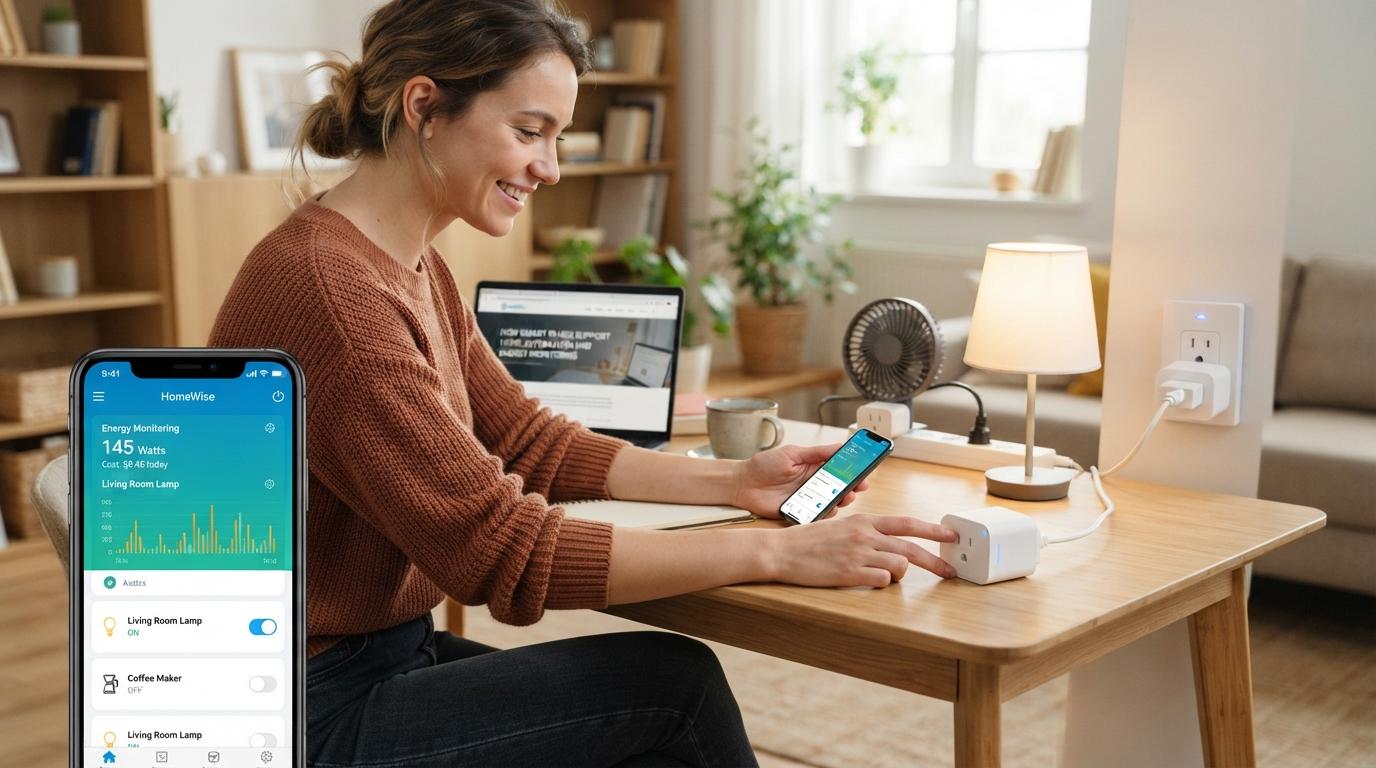
Smart plugs are often introduced as a simple remote-control convenience, but their role in a broader home automation and energy monitoring strategy is considerably more interesting once you look past the basic on/off function.
A single smart plug controls one appliance. Multiple smart plugs across a household, combined through a shared app or voice assistant, start to form the foundation of genuine home automation — coordinated schedules, routines that adjust several devices together, and a household-wide view of connected device activity.
Individually, a power-monitoring smart plug tells you about one appliance's usage. Collectively, monitoring several key appliances across a household builds a genuinely useful picture of where your overall electricity consumption is actually going — information that's difficult to obtain any other way without professional energy auditing equipment.
Beyond a single snapshot of usage, tracking consumption data over weeks or months can reveal patterns — seasonal changes in appliance usage, gradual increases suggesting a device's efficiency is declining, or unexpected spikes worth investigating — insights that a monthly electricity bill alone doesn't provide in nearly the same detail.
More advanced home automation setups can move beyond simple fixed-time schedules toward automation based on actual conditions — a smart plug triggered by a sensor detecting occupancy, rather than a rigid schedule that doesn't account for whether anyone is actually home.
For households actively managing a budget around utility costs, the granular data from monitoring-capable smart plugs can feed into more informed decisions — whether replacing an older, inefficient appliance makes financial sense, based on actual measured consumption rather than an estimate.
Smart plugs, being the simplest and cheapest entry point, often serve as the foundation household members use to get comfortable with app-based and voice control before expanding into smart switches, sensors, and more integrated automation — the monitoring habit and comfort with the technology built through smart plugs tends to carry forward into a more ambitious setup later.
It's worth being clear that consumer smart plugs offer a genuinely useful, accessible starting point for automation and monitoring, but they're not equivalent to a professionally installed, whole-home energy management system — for anyone with more serious energy monitoring or automation needs (a larger property, business premises), a more comprehensive professional solution may be worth exploring separately.
As with any connected home device, it's worth being aware that smart plugs collect and transmit usage data through their companion apps, generally to provide the monitoring features themselves — reviewing a manufacturer's privacy practices, particularly for a device that will be tracking household usage patterns over time, is a reasonable step before extensively relying on any connected home ecosystem.
Rather than trying to build a fully integrated, automated household all at once, starting with a few strategically placed monitoring-capable smart plugs, understanding the data they provide, and then expanding automation based on what you actually learn tends to produce a more genuinely useful, well-tailored smart home setup than an all-at-once approach.
For households in Pakistan interested in moving beyond basic remote control toward genuine energy monitoring and automation, a range of smart plugs with monitoring features, alongside compatible sensors and switches for later expansion, provides a practical foundation to build from incrementally.
Start with power-monitoring smart plugs on your highest-consumption appliances
Track usage patterns over weeks or months, not just a single reading
Consider sensor-based automation once comfortable with basic scheduling
Use monitoring data to inform real decisions (appliance replacement, usage changes)
Review privacy practices for any connected device collecting household usage data
Smart plugs are a genuinely useful foundation for both home automation and practical energy monitoring, particularly when their data is actually used to inform decisions rather than just collected passively — the real value builds over time as you learn from and act on what the devices reveal about your household's actual usage.