Indonesia
 English
 Arabic
 French
 Spanish
 Portuguese
 Deutsch
 Turkish
 Dutch
 Italiano
 Russian
 Romaian
 Portuguese (Brazil)
 Greek
Can Sebaceous Cyst Removal Be Performed in a Dermatology Clinic?
Health |
2026-10-29 08:12:45
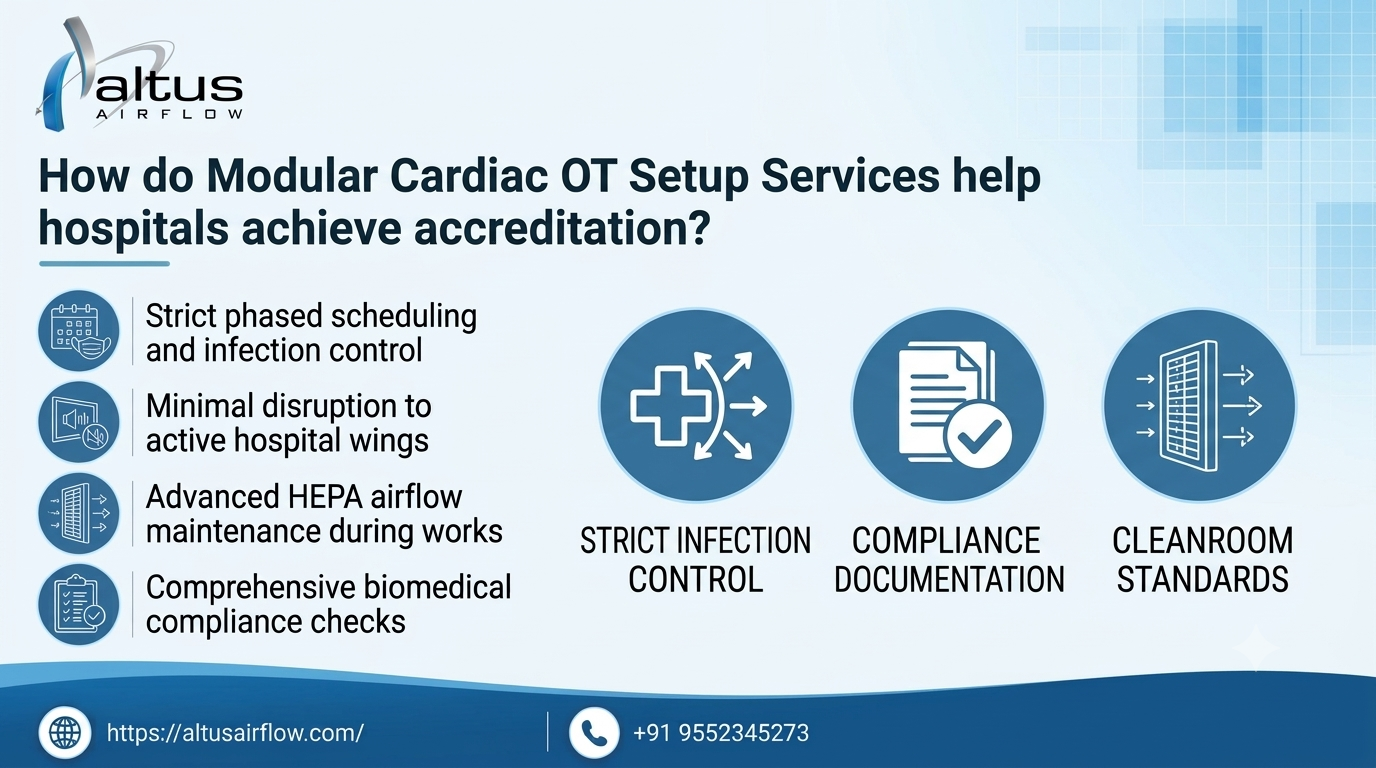
Altus Airflow supports healthcare facilities in planning and developing modular cardiac operation theatres that align with their infrastructure, safety, and operational requirements. Modular Cardiac OT Setup Services help hospitals prepare for accreditation by coordinating theatre design, ventilation systems, infection prevention measures, electrical infrastructure, equipment integration, documentation, and performance testing. Accreditation assessments often examine whether healthcare facilities follow established standards, maintain appropriate records, and operate systems safely and consistently. A well-planned cardiac OT project can help hospitals address relevant infrastructure requirements, organize technical documentation, and establish procedures that support ongoing quality improvement. However, accreditation depends on the hospital’s overall compliance and assessment results, not on infrastructure installation alone.
Hospital accreditation evaluates whether a healthcare facility follows defined standards for patient safety, clinical processes, infection prevention, infrastructure, and quality management. The specific requirements depend on the accrediting organization, applicable regulations, and the scope of assessment.
For cardiac operation theatres, hospitals may need to demonstrate that the environment is appropriately designed, essential services function reliably, equipment is maintained, and staff follow documented procedures. Assessors may also review records related to maintenance, environmental monitoring, cleaning, emergency preparedness, and corrective actions.
Before beginning a renovation or new theatre project, hospital administrators should identify the standards applicable to their facility. The engineering team, quality department, infection prevention personnel, and clinical representatives can then translate relevant requirements into practical design and operational specifications.
This early review helps prevent expensive modifications later. For example, if the hospital needs specific environmental monitoring records or defined equipment access arrangements, these expectations should be considered during design rather than after construction.
Infrastructure improvements can support accreditation readiness, but hospitals must also address staffing, clinical governance, patient care procedures, and other organizational requirements.
The physical layout of a cardiac operation theatre influences staff movement, cleaning practices, equipment placement, and coordination during surgical procedures. An unsuitable layout can create workflow difficulties and make it harder to maintain consistent operating procedures.
A structured design process considers the operating table, surgical lights, medical equipment, staff positions, storage, doorways, service outlets, and access to supporting areas. The arrangement should reflect the hospital’s clinical needs and the requirements of applicable standards.
Modular walls, ceilings, doors, and other components should be selected according to their intended use, durability, cleaning compatibility, and installation requirements. Joints and penetrations should be finished carefully to avoid unnecessary dust-collection points and support routine cleaning.
Design documents should clearly identify materials, dimensions, service locations, and relevant technical specifications. These records help the hospital verify that the completed installation matches the approved design.
Modular Cardiac OT Setup Services can coordinate design decisions with engineering consultants, hospital administrators, and clinical teams. This coordination helps connect infrastructure planning with documented requirements and provides a clearer basis for inspections and project acceptance.
Infection prevention is an important consideration in operating theatre design and hospital accreditation. The infrastructure should support established cleaning procedures, appropriate environmental controls, and effective management of contamination risks.
Hospitals should evaluate wall and floor finishes, ceiling systems, doors, work surfaces, and service penetrations for suitability in the intended clinical environment. Materials should be compatible with approved cleaning and disinfection procedures.
Ventilation design also contributes to environmental control. Depending on applicable standards and the theatre’s intended use, the hospital may need specified filtration, airflow performance, air-pressure relationships, and environmental monitoring arrangements.
Construction activities require separate infection prevention measures. When a theatre is renovated near occupied clinical areas, the project team should coordinate barriers, dust control, waste movement, cleaning, and access restrictions with the hospital’s infection prevention department.
Documentation should show how relevant controls are planned, implemented, inspected, and maintained. Staff should also understand their responsibilities for cleaning, reporting concerns, and responding to environmental deviations.
These measures help demonstrate that the facility has considered infection prevention in both its infrastructure and day-to-day operating procedures. They do not independently guarantee accreditation or eliminate infection risks.
Ventilation and environmental control systems must be suitable for the theatre’s approved design and applicable technical requirements. Hospitals may need to demonstrate that these systems are installed correctly, tested, maintained, and monitored.
During planning, the engineering team should assess air-handling equipment, ductwork, filtration, airflow distribution, temperature controls, humidity controls, and pressure-monitoring arrangements. Existing systems should not be assumed suitable without an appropriate assessment.
After installation or modification, qualified personnel should perform the required commissioning and verification tests. Depending on the specifications, these may include airflow measurements, pressure differential checks, temperature and humidity verification, and filter integrity testing where required.
The results should be recorded and reviewed against the approved acceptance criteria. Deviations should be investigated, corrected, and retested as appropriate.
Hospitals should also establish ongoing monitoring and maintenance schedules. Records can include inspection dates, measured values, calibration information, service activities, alarm events, and corrective actions.
A Modular Cardiac OT Setup Services project can help coordinate the installation and testing of these systems when included in the agreed scope. The hospital remains responsible for ensuring that ongoing monitoring, maintenance, and operational procedures meet its applicable requirements.
A cardiac operation theatre relies on dependable electrical systems and properly coordinated clinical services. Electrical faults, poorly planned connections, or inadequate maintenance can affect equipment availability and create safety concerns.
The project team should assess power distribution, equipment circuits, protective devices, grounding, lighting, and essential power arrangements according to applicable electrical and healthcare requirements. The design must also account for the demands of the selected medical equipment.
Where required, backup power systems should be specified and tested to confirm that they operate as intended. Hospitals should maintain procedures for power interruptions, equipment shutdowns, restoration, and reporting.
Medical gas services and other essential utilities should be included in the assessment when they form part of the project scope. Qualified professionals should complete the necessary installation checks and functional tests.
Documentation may include electrical drawings, test reports, equipment schedules, maintenance records, and details of backup arrangements. These documents help the hospital demonstrate that relevant systems have been evaluated and that responsibilities for inspection and maintenance are defined.
Accreditation readiness depends not only on the presence of suitable infrastructure but also on evidence that it is operated safely and maintained according to established procedures.
Cardiac operation theatres use specialized equipment such as surgical lights, operating tables, anaesthesia systems, patient monitors, and other devices required for clinical workflows. The exact equipment list depends on the hospital’s services and project scope.
Equipment placement should be coordinated with the theatre layout, electrical connections, ventilation requirements, access routes, and maintenance needs. This reduces the likelihood of installation conflicts and supports efficient use of available space.
Before equipment is accepted for use, the hospital should complete the applicable installation and performance checks. These may include functional testing, electrical safety checks, alarm verification, calibration, and manufacturer-specific acceptance procedures.
An equipment inventory should record identifying information, installation dates, service contacts, maintenance schedules, calibration requirements, and warranty details. Records should be updated when equipment is repaired, relocated, or replaced.
Hospitals should also establish procedures for reporting faults and taking defective equipment out of service where necessary. Maintenance records help demonstrate that equipment management is systematic rather than dependent on informal arrangements.
When infrastructure and equipment are coordinated during the project, the hospital has a stronger foundation for maintaining the records and procedures that may be reviewed during accreditation assessments.
Accreditation assessments frequently involve reviewing evidence that systems and processes meet relevant requirements. Even when infrastructure is suitable, incomplete or inconsistent documentation can make it difficult to demonstrate compliance.
A well-organized handover package may include approved drawings, material specifications, equipment manuals, warranties, commissioning reports, test certificates, maintenance instructions, and relevant training records.
The hospital should maintain these documents in an accessible system with clear ownership and version control. Authorized staff should know where records are stored and how to retrieve them when needed.
Technical records should be linked to the relevant equipment or system wherever practical. For example, a ventilation maintenance record should identify the system serviced, the work completed, the date, the technician, and any findings requiring follow-up.
Documentation must accurately reflect the work performed. Records should not be created retrospectively to imply that a test, inspection, or approval occurred when it did not.
The quality department can work with engineering and clinical teams to map relevant accreditation requirements to the evidence available. Any gaps should be identified early and addressed through legitimate inspections, testing, training, or process improvements.
Accreditation readiness is an ongoing responsibility rather than a one-time project milestone. Hospitals need procedures that help maintain infrastructure performance after the theatre becomes operational.
Preventive maintenance schedules should cover relevant systems, including ventilation equipment, electrical installations, monitoring devices, modular finishes, doors, and other installed components. Frequencies should follow manufacturer recommendations, risk assessments, applicable standards, and hospital policy.
Each maintenance activity should be documented. If a defect is identified, the hospital should record the issue, assign responsibility, complete the corrective action, and verify the outcome.
Quality procedures should also address recurring problems. Repeated alarms, equipment breakdowns, or environmental deviations may indicate that the underlying cause has not been resolved. Reviewing trends can help the hospital decide whether additional maintenance, staff training, or technical modifications are needed.
Internal audits can check whether staff follow established procedures and whether records are complete. Findings should be reviewed by the responsible teams and tracked until appropriate actions are completed.
This approach supports continuous improvement and helps the hospital maintain evidence of ongoing oversight.
Accreditation-related infrastructure work involves several departments and external specialists. Hospital administrators, clinical teams, engineers, biomedical personnel, infection prevention staff, quality managers, contractors, and equipment suppliers may all contribute to the project.
Without clear responsibilities, important decisions can be delayed or overlooked. The project plan should identify who approves drawings, reviews technical specifications, arranges testing, maintains records, and accepts completed work.
Regular coordination meetings help teams discuss progress, outstanding issues, and risks. Decisions should be documented, particularly when they affect approved designs, budgets, schedules, or compliance requirements.
Before work begins, the hospital should agree on acceptance criteria and the documentation required for handover. This makes it easier to assess whether the completed installation meets the approved scope.
A Modular Cardiac OT Setup Services provider can assist with coordinating the infrastructure activities assigned under its contract. However, clinical governance, hospital-wide quality management, and final accreditation decisions remain with the relevant hospital authorities and accrediting organization.
Commissioning verifies that installed systems operate according to the approved design and project specifications. It should be planned early so that testing responsibilities, methods, acceptance criteria, and required records are clearly understood.
The commissioning process may include inspections of modular components, ventilation performance, electrical systems, lighting, utility connections, alarms, and installed equipment. The precise tests depend on the systems supplied and applicable requirements.
Qualified personnel should document the results and identify any deviations. Defects should be corrected, and affected systems should be retested before acceptance.
A final readiness review can bring together engineering records, maintenance procedures, staff training, cleaning arrangements, equipment inventories, and unresolved issues. The hospital should confirm that the necessary approvals are complete before the theatre is placed into clinical service.
If accreditation is approaching, the quality team can compare available evidence with the relevant standards and identify outstanding gaps. This review should cover both infrastructure and operational procedures.
Commissioning and readiness checks provide important evidence, but they do not replace the accrediting body’s assessment or guarantee a successful outcome.
Preparing a cardiac operation theatre for hospital accreditation requires coordinated design, suitable materials, reliable environmental and electrical systems, equipment management, preventive maintenance, and accurate documentation. Modular infrastructure can help hospitals organize these requirements, provided that the design and installation meet applicable standards and the facility maintains appropriate operational procedures.
Altus Airflow supports healthcare facilities in coordinating modular operation theatre infrastructure, technical installations, and project documentation. By working with Altus Airflow, hospitals can develop a structured approach to infrastructure readiness, system verification, and ongoing maintenance while addressing the broader clinical and administrative requirements of accreditation.
Modular Cardiac OT Setup Services help coordinate theatre design, environmental controls, electrical infrastructure, equipment integration, testing, and documentation that may support accreditation requirements.
No. Accreditation depends on the hospital’s overall compliance with the applicable standards, including clinical processes, staffing, safety, documentation, and infrastructure.
HVAC testing provides evidence that relevant ventilation and environmental systems meet their approved performance criteria.
Common records include approved drawings, commissioning reports, equipment inventories, maintenance logs, calibration records, test results, and relevant training documentation.
Suitable modular surfaces, carefully finished joints, and coordinated environmental systems can support cleaning and infection prevention procedures when properly designed and maintained.
Read Our Previous Blog --------------->How do you compare different Andrology Room Design Company providers?